Friday, 25 November 2016

Wear Your Old Band T-Shirt To Work Day

This year colleagues from HEDS including Information Resources own Anthea Sutton Back row right) and Andy Tattersall (back row third from right) took part again in BBC Radio 6 Music's 'Wear Your Old Band T-Shirt To Work Day'.  Anthea donned her 2000 edition Blur t shirt, whilst Andy bent the rules a bit and wore an Upsetter Records t shirt, the label set up by Lee Scratch Perry. Frank the Skeleton can also be seen in a fetching Depeche Mode t shirt, also belonging to Anthea.
Our own Claire Beecroft sent a Portishead selfie from home.

The usual suspects…….2015’s post.

Image of HEDS staff
'Wear Your Old Band T-Shirt To Work Day'
Image of Claire Beecroft
Claire Beecroft

Monday, 14 November 2016

An Advanced Guide to using Social Media and the Web to Communicate and Measure your Research Impact - 1 day course: Wednesday, 25th January 2017


Image of Andy Tattersall
Andy Tattersall

Image of Claire Beecroft
Claire Beecroft
 Many academics and professionals are already using social media tools such as Twitter, blogging and ResearchGate as part of their work. Some are using the tools daily, whilst most just dip in and out of using them for a variety of reasons. Whilst Twitter and ResearchGate are useful, they are just a small part of a large set of tools that academics can use to communicate and network. Andy Tattersall and Claire Beecroft are running a one day workshop that helps academics and professionals make better use of the tools they may already be using.


Some academics are using the wrong tools and others just not getting the best out of them. Open access, data re-use and scholarly communications are opening up a myriad of further options on how research can be archived, shared and re-used, and the workshop will look at the options available to transform any academic into a modern digital academic.

Course Overview

This one day course will show academics and professionals who will have some experience of using some of these tools but are not quite sure how to maximise them and what other options exist. We will show you how to get more from your mobile device from presentations to conference calling, from taking polls to making videos, and how you can truly be a digital academic fit for the 21st Century.


We will look at the options around self-archiving and the benefits, barriers and pitfalls for doing so. The workshop will also look at different ways of communicating and sharing your research with special attention to infographics, video, podcasting and animation.
Communicating research is only part of the story and we will look at how altmetrics can be employed to show what is being said about your research and how you should respond. We will also explore the ethical and practical issues around open peer review and public comments and how you can deal with them.


Who will benefit from this course?
This short course will benefit a wide range of people including (but not exclusive of):
  • Researchers;
  • Masters and PhD Students;
  • Research Support Staff and Managers;

Course Materials

A copy of all course materials will be provided on USB (including presentations).  Participants are asked to provide their own laptop/tablet for the duration of the course


Date and Times
1-day course:  Wednesday, 25th January 2017
Start:  9:30 am
Finish: 4:30 pm

Fees

£TBC - Early Bird Rate for confirmed bookings received on or before Sunday, 27th November 2016
£TBC - Standard Rate for confirmed bookings received on or after Monday, 28th November 2016
Last Booking date for this course is midnight on Wednesday, 11th January 2017

Booking and Payment

Provisional bookings are now being accepted. Please email scharr-scu@sheffield.ac.uk to reserve your place. You will then be contacted when the course has gone live on the Online Store, where all our bookings are processed.

All our bookings are processed via our Online Store. Payment is by Credit/Debit Card or PayPal. If you are a UK organisation and would prefer to be invoiced, then please select this option on our Online Store and ensure that all invoice details are provided (contact email address, full address, purchase order number) and also forward a copy of the Purchase Order to scharr-scu@sheffield.ac.uk.
If you have any queries regarding our booking process then please do not hesitate to contact us.

Meals and Accommodation

The course fee includes lunch and refreshments throughout the day plus all course materials provided on USB and teaching fees.  NB:  Accommodation is NOT included.
If you have any particular dietary or access requirements then please contact the Short Course Unit with your requirements at the time of booking.

Venue


Halifax Hall Hotel & Conference Centre

Endcliffe Vale Road, Sheffield, S10 3ER.
www.halifaxhall.co.uk

Contact

For further information please do not hesitate to contact the Short Course Unit via email at scharr-scu@sheffield.ac.uk


 Tel +44 (0)114 222 2968

Thursday, 10 November 2016

ScHARR Library Open Day

The ScHARR Library welcomed all staff and students to its annual open day on Thursday 20th October 2016 . The Open Day proved to be very popular, and the library was busy throughout the day with students and staff. Our  Information Specialists provided a number of well attended drop-in sessions. There was also an exciting competition and if that wasn’t enough, there was a bake sale raising money for Amnesty International, in memory of our colleague Tony Mead.


Drop-in Sessions
Our Information Specialists shared their expertise:
  • Helen Buckley Woods presented an overview of IRIS - Information Resources Information Study Skills. This is an online course for ScHARR Students which assists with student Information literacy understanding and competency.
  • Magda Bell our resident expert on Inter-Library Loans and Copyright talked about the service offered in ScHARR and dealt with any copyright queries from staff and students
  • Anthea Sutton presented an overview  of the Systematic Review Toolkit, demonstrating how this tool can be used for searching, study selection, quality assessment and more.
  • Information Specialists deliver a session
    Information Specialists deliver a session
    Angie Rees talked about how to use and get the best out of Google Scholar. What it’s good for and what it’s not so good for.
  • Claire Beecroft  provided guidance on how to quickly and easily improve your searching to ensure nothing is missed by using citation searching and reference lists. Essential for all types of reviews.


Competition Time!
prize_display.jpg
ScHARR Library Open Day Competition
Sonia Rizzo organised a tough but fun competition ‘Guess the 1st tune’ with lots of great prizes courtesy of Dialectable.  Liz Kitchen and Jean Hamilton came joint first in the competition and collected lots of lovely goodies!


Bake Sale - Raised £150 for Amnesty International!
Finally, there were lots of delicious home baked cakes made by the Information Resources team. These went down well with students and staff! An amazing £150 was raised  for Amnesty International,  in memory of our colleague Tony Mead. Tony worked in the ScHARR Library for nearly a decade and Amnesty International  was Tony’s favourite charity.


A big thank you to everyone who came to the Open day,  and a big thank you to everyone who helped out, we couldn’t have done it without you!


Wednesday, 2 November 2016

App Hacks - Some of the best research and medical apps

Image of Andy Tattersall
Andy Tattersall
Andy Tattersall and ScHARR Learning Technologist Dan Smith have created a series of short informative videos called App Hacks. The videos are to help academics and students, especially in a medical and healthcare setting see useful apps in action and make an informed choice as to their application and use. 
App Hacks Logo
App Hacks

The apps were captured on screen and gives potential users a basic but informative tour. The videos range from research and annotation tools like Mendeley to Evernote, to content creation like Adobe Spark and Haiku Deck as well as healthcare apps such as Medline Prime and NICE Guidance. The videos are hosted on the ScHARRvid YouTube Channel and soon on the University of Sheffield's iTunes U Channel.

The playlist can be viewed here:
App Hacks


RefMe


Evernote

Monday, 31 October 2016

ScHARR Information Resources Group at ISPOR European Congress

Image credit: Viennascape by Nic Piégsa
. This work is licensed under a CC BY 2.0 license.

This week, ScHARR Information Resources Group will be represented at the ISPOR 19th European Annual Congress by Suzy Paisley (Director of Innovation and Knowledge Transfer) and Anthea Sutton (Information Resources Group Manager).

Along with other members of the HEDS team, Suzy and Anthea are contributing to the busy conference programme with a poster presentation each.  Suzy on the topic of "Identifying Early Biomarkers of Acute Myocardial Infarction in the Biomedical Literature: A Comparison of Text Mining and Manual Sifting Techniques".  Anthea will be representing the Systematic Review Toolbox, in collaboration with Chris Marshall from YHEC.  Both posters can be viewed between the hours of 08:45 and 14:15 on Monday 31st October, with an author discussion hour at 13.15, do come along and find out about this work.

For the remainder of the congress, Suzy and Anthea can be found, along with the rest of the HEDS expert team, at exhibition Stand no. 20/21.  This provides a great opportunity to find out about opportunities to work with ScHARR to support key strategic developments in your organisation, to collaborate with us on research and to participate in our diverse, world class learning and teaching programmes.

The full ScHARR HEDS congress activity can be found here. We'll be tweeting from @ScHARR_IKT during the congress, so please follow us there.

Friday, 28 October 2016

LSE Book Review of Altmetrics: A Practical Guide for Librarians, Researchers and Academics


Image of Andy Tattersall
Andy Tattersall
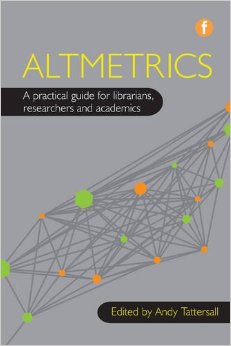
Altmetrics: A Practical Guide for Librarians, Researchers and Academics, edited by Andy Tattersall, provides an overview of altmetrics and new methods of scholarly communication and how they can be applied successfully to provide evidence of scholarly contribution and improve how research is disseminated. The book, which draws on the expertise of leading figures in the field, strongly encourages library and information science (LIS) professionals to get involved with altmetrics to meet the evolving needs of the research community, finds Nathalie Cornée.

Altmetrics: A Practical Guide for Librarians, Researchers and Academics. Andy Tattersall (ed.). Facet Publishing. 2016.

Find this book: amazon-logo

altmetrics-cover

Back in 2010, a new field of scholarly communication research was burgeoning: altmetrics. Altmetrics (initially standing for alternative metrics) are part of the broader range of scholarly metrics, such as the impact factor, citation counts or the h-index. They primarily intend to provide an indication of online and social media attention to any research outputs (as opposed to established metrics focusing mainly on peer reviewed publications only) by capturing their social influence. By doing this, they aim to improve our understanding about how information about research propagates, how it is used and how scholars are engaging with these new forms of scholarly communication.

Today, altmetrics are no longer regarded as alternative, but rather as complementary to traditional metrics. Many advocate their use as ‘early indicators’ of article usefulness. Indeed, research that used to take months or years to reach readers can now find them almost instantly via blogs, Wikipedia, social media networks, etc. Activities that used to be hidden, such as reading or downloading a paper, are now visible and therefore traceable (see Ben Showers, Chapter Four). Many stakeholders within academia are looking for new ways to measure how outputs are consumed online before they even start accruing citation counts (which take years for most disciplines).
In Altmetrics, the authors begin by explaining where altmetrics sit within the research landscape, the importance of research evaluation for scholarship and employment decisions, benchmarking purposes, funding opportunities, etc, as well as the notion of prestige or influence which is deeply rooted within academia.

Chapter Three, ‘Metrics of the Trade – Where Have We Come From?’ by Andrew Booth, provides a comprehensive review of the established metrics, and is a must-read for anyone less familiar with the broader world of scholarly metrics. By explaining their goal as well as their actual use in assessing individuals, groups or journal performance, Booth opens up the context in which altmetrics started to flourish and the gap that they have been trying to fill.
Throughout the book, Andy Tattersall insists on the cultural shift that academia has witnessed over the last decades: namely, since the development of the Internet and its related technologies (including MOOCs, Big Data, Open Access). Even though scholars were initially relatively quick to adopt some of the new means of communication that the digital world had to offer, such as emails, Tattersall reminds us that a vast majority of scholars tend to be rather apprehensive in utilising some of the new means of scholarly communication, firstly because of the downpour of technologies and platforms now available to them, and secondly because they rightly question their validity.

altmetrics-image
Image Credit: (dirkcuys CC BY SA 2.0)
While the first half of Altmetrics focuses mainly on setting the scene for new scholarly communications, the second half tends to emphasise the vital role that library and information professionals can play in helping staff discover and communicate research and ultimately reinforce their outreach activities within their own institutions.
LIS professionals are clearly the first target audience of this book, even though academics, publishers, funders or stakeholders of the research evaluation process could apply the recommendations to some extent. That said, throughout the book the authors stress how well-suited librarians are to supporting researchers. Indeed, librarians have developed a key presence within the research cycle by being experts in managing academic content either through collections, subscriptions or institutional repositories. They are also highly regarded within the academic community for their advice on copyright issues, support with information discovery and literacy, and have more recently become very proficient in facilitating open access publishing.

Chapter Ten, ‘The Connected Academic’, particularly struck a chord with me as Tattersall relays some of the major and very legitimate questions scholars tend to have about altmetrics, including ‘is this system good quality?’, ‘is this system stable?’ and ‘why use this technology, could it just be a fad?’ (141). If LIS professionals succeed in answering some of these questions that academics (or research administrators) may have by not providing them with just technical answers but rather by tailoring their response to each individual case, this will indeed help them strengthen their relationships and role within their organisation. I would have liked this chapter to go even further and provide successful stories of LIS professionals doing just that as every scholar will have different reasons for developing their online presence.

As the subtitle of Altmetrics stresses, it aims to be ‘practical’. Chapter Eight, ‘Resources and Tools,’ written by Tattersall, provides a short introduction to 41 resources including the major altmetrics tools as well as many social media platforms, some of which have an academic focus while others tend towards the mainstream. This list was useful in itself as some were new to me, but the real difficulty we face as LIS professionals is convincing our academics how valuable these tools can be to them and which ones to select and invest time in. Here again, concrete examples of scholars having developed strategies and workflows in which they have effectively combined these various outreach activities of sharing, connecting and measuring would have been beneficial. Tattersall does include, however, some helpful tips and tricks, such as identifying a ‘twin’ to demonstrate the value of disseminating research and engaging online (150). The author defines this as someone who would be a scholar’s highly respected peer, but based in another organisation and who has been successfully active on social media platforms.

The field of altmetrics has grown exponentially to the point that they are now considered as part of the basket of metrics recommended by the Leiden Manifesto or the Metric Tide Report, which both advocate the use of responsible metrics. The field has also attracted lots of groundbreaking research about the opportunities and challenges they bring in terms of their meaning or validity. Altmetrics: A Practical Guide for Librarians, Researchers and Academics is very welcome as it is one of very few textbooks revisiting the theory behind the growth of altmetrics, providing a comprehensive snapshot of what they look like today and demonstrating their value if applied in a meaningful manner. All in all, this is a worthwhile read, especially for any LIS professional interested in improving their understanding of altmetrics.


Nathalie Cornée is LSE Library’s Research Information Analyst. In her role, Nathalie focuses on providing support and training in all aspects of bibliometrics and citation analysis to researchers, administrative and research support staff to help them in getting some understanding of how the metrics are calculated and how they can be used to maximise the visibility and exposure of their research findings.
Note: This review gives the views of the author, and not the position of the LSE Review of Books blog, or of the London School of Economics. 

Creative Commons Attribution-NonCommercial-NoDerivs 2.0 UK: England & Wales 

Thursday, 27 October 2016

An Introduction to using Social Media to Communicate Research - 1-day course: Thursday, 24th November 2016


Image of Andy Tattersall
Andy Tattersall
Claire Beecroft
Claire Beecroft
Andy Tattersall and Claire Beecroft are running a one day workshop in Sheffield -  An Introduction to using Social Media to Communicate Research. The workshop aims to give academics and aligned professionals a comprehensive guide to social media and how it can be applied in scholarly communications.

The treadmill of academia is a relentless one: proposal, research, write, present and then hopefully publish before starting all over again, all in the hope that the research is recognised as being of good quality, worthy and valuable. There's one problem though - journals are not geared up for the modern online world of instant sharing and communication. Tools and ways of communicating research such as Twitter, YouTube, ResearchGate, Slideshare, blogging, infographics, animation and many others will be covered. The good news is they are mostly free and can work together to help research to reach a wider audience. That audience is not just academic peers, but publishers, editors, fund holders and the general public.

Course Overview
The aim of the workshop is to offer an introduction to the many tools you can use to help you communicate research and work smarter. The purpose of the day is to help attendees come away with a variety of tools and artefacts they can use to help communicate and share their work. We will teach you basics of social media in an academic setting and demystify some of the barriers that may have put you off from using these tools in your work.

We will show you how to make the most from these technologies and show you how to find out alternative ways of discussing and communicating research. Attention will be paid to the various ethical issues to working more on the web from copyright and Creative Commons to making more use of your mobile device, from safety and security to how you conduct yourself online and netiquette.

Who will benefit from this course?
This short course will benefit a wide range of people including (but not exhaustive of):


  • Researchers,
  • Masters and PhD students,
  • Research Support Staff and Managers,
  • Library and Information Professionals,
  • Communications and Marketing Professionals.

Date and Times
1-day course:  Thursday, 24th November 2016
Start:  9:30 am
Finish: 4:30 pm

Fees

£400 - Standard Rate for confirmed bookings

Booking and Payment


Provisional bookings are now being accepted. Please email scharr-scu@sheffield.ac.uk to reserve your place. You will then be contacted when the course has gone live on the Online Store, where all our bookings are processed.

All our bookings are processed via our Online Store. Payment is by Credit/Debit Card or PayPal. If you are a UK organisation and would prefer to be invoiced, then please select this option on our Online Store and ensure that all invoice details are provided (contact email address, full address, purchase order number) and also forward a copy of the Purchase Order to scharr-scu@sheffield.ac.uk.
Last Booking date for this course is midnight on Sunday, 13th November 2016.
If you have any queries regarding our booking process then please do not hesitate to contact us.

Meals and Accommodation

The course fee includes lunch and refreshments throughout the day plus all course materials provided on USB and teaching fees.  NB:  Accommodation is NOT included.
If you have any particular dietary or access requirements then please contact the Short Course Unit with your requirements at the time of booking.

Venue


Halifax Hall Hotel & Conference Centre

Endcliffe Vale Road, Sheffield, S10 3ER.
www.halifaxhall.co.uk

Contact

For further information please do not hesitate to contact the Short Course Unit via email at scharr-scu@sheffield.ac.uk


or call +44 (0)114 222 2968.